The Romantic Sublime Triptych
A unified tripartite visual synthesis bridging the three poetic movements of Coleridge's masterwork.
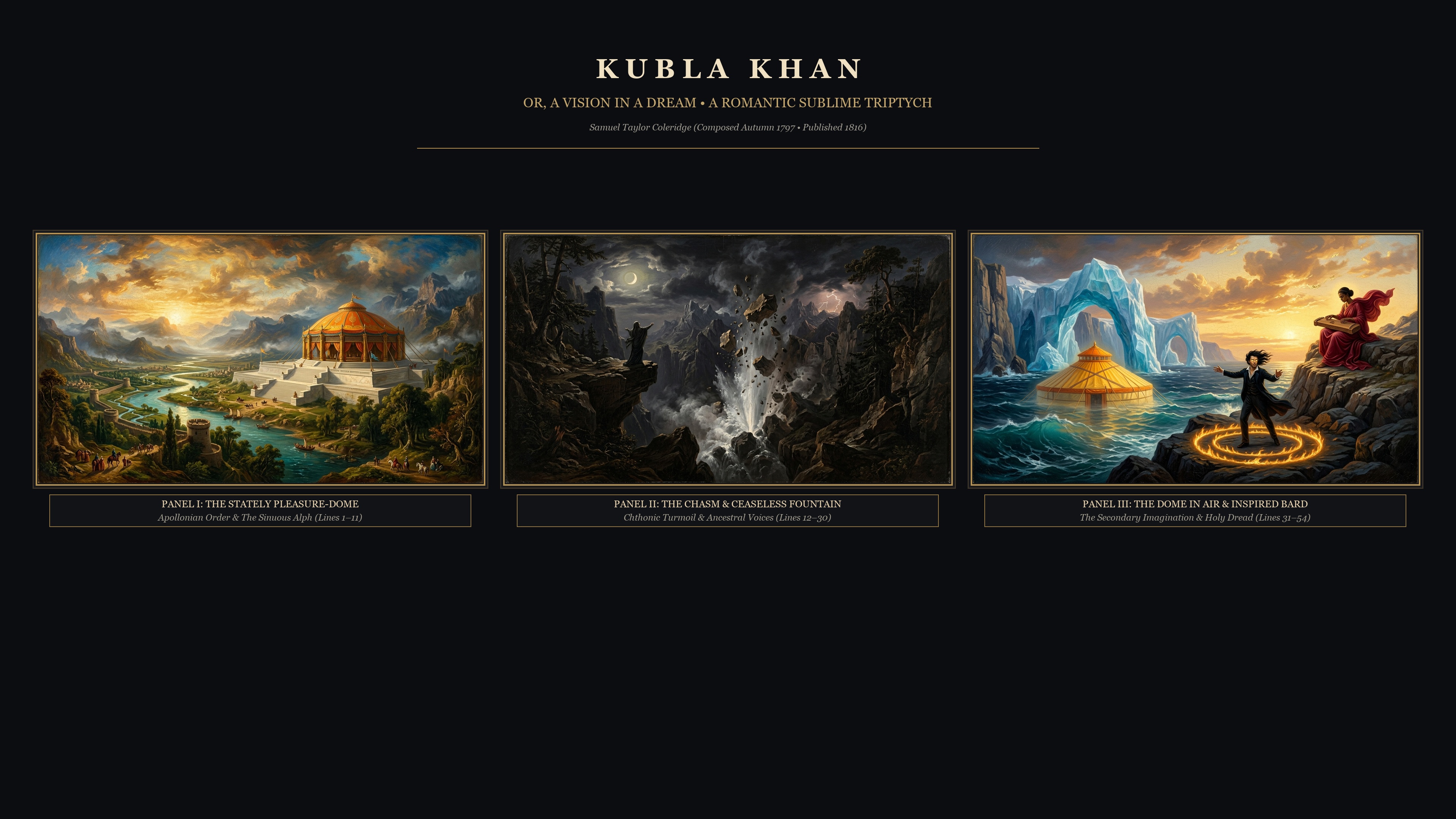
I. The Imperial Enclosure (Lines 1–11)
Apollonian order and geometric containment: Kubla's stately pleasure-dome, twice five miles of girdled fertile ground, and sinuous rills.
II. The Chthonic Chasm (Lines 12–30)
The Dionysian eruptive sublime: The boiling fountain, vaulting boulders, demonic wailing, and ancestral voices prophesying war.
III. The Secondary Imagination (Lines 31–54)
The Poetic Apotheosis: The Abyssinian Maid's dulcimer, the sunny dome with caves of ice, and the inspired bard consumed by holy dread.
Canonical Text & Crewe Holograph Variants
Read the canonical 1816 printed text alongside key textual variants from the Crewe Holograph (BL Add MS 50847).
1816 Printed Text
The Crewe Holograph Apparatus
The Three Critical Study Modules
Key analytical frameworks for classroom discussion and Band 6 / E4 essay construction.
The Liminal World of 1797 & Metric Enclosure
Explores the historical Nether Stowey composition circumstances and the clash of political crisis with metric containment.
- 1797 Invasion Scares: Britain on war footing with Revolutionary France; Coleridge shadowed by Home Office spies.
- Apollonian Enclosure: "Twice five miles of fertile ground" represents conscious metric discipline.
- Purchas His Pilgrimage (1613): The source text (Book IV, Ch. XIII, p. 418: "In Xamdu did Cublai Can build a stately Palace...") transformatively reimagined into an organic vision.
The Porlock Paradox & The Crewe Holograph
Investigates textual transmission, manuscript instability, and the psychological function of the fragment.
- The Porlock Debate: Did the visitor exist, or does the preface function as a Romantic aesthetic defense mechanism for impossible artistic completion?
- Crewe Holograph (BL Add MS 50847): Preserved in Elizabeth Smith's collection and Crewe family papers until 1962; textual variations confirm deliberate poetic revision rather than passive transcription.
- Organic Unity: Why modern critics (Humphry House, Jack Stillinger) argue the poem is structurally complete.
Biographia Literaria & Secondary Imagination
Analyzes Coleridge's philosophical system of primary perception versus conscious secondary creation.
- The Road to Xanadu: John Livingston Lowes reveals the associative alchemy of Coleridge's reading notebooks.
- Coincidentia Oppositorum: The miraculous reconciliation of sunny warmth and glacial ice.
- The Inspired Bard: "Flashing eyes, floating hair"—divine Platonic madness (Furor Poeticus) and holy dread.
Scholastic Bibliography & Archival Apparatus
Full primary manuscript shelfmarks, first editions, and peer-reviewed secondary monographs with specific chapter and page references for undergraduate and graduate research.
Manuscripts, Editions & Eyewitnesses
Original physical records and contemporary Regency oral reception accounts:
- British Library Add MS 50847: Autograph fair copy by S. T. Coleridge (c. 1797–1804). Forwarded by Robert Southey to polymath Elizabeth Smith in Feb 1804; acquired by British Museum in 1962.
- Coleridge, Samuel Taylor: Christabel: Kubla Khan, a Vision; The Pains of Sleep (London: Printed for John Murray, Albemarle-Street, by William Bulmer and Co., 1816), pp. 49–58. [First Printed Edition].
- Purchas, Samuel: Purchas His Pilgrimage; or Relations of the World and the Religions Observed in All Ages (London: William Stansby, 1613), Book IV, Ch. XIII, p. 418. [Coleridge's source text].
- Coleridge, Samuel Taylor: Biographia Literaria; or Biographical Sketches of My Literary Life and Opinions (London: Rest Fenner, 1817), Vol. 1, Ch. XIII ("On the Imagination"), pp. 295–306.
- Hazlitt, William: "My First Acquaintance with Poets," The Liberal: Verse and Prose from the South, Vol. 2 (London: John Hunt, 1823), pp. 23–46. [Recollection of Coleridge's 1798 voice].
- Hunt, Leigh: Lord Byron and Some of His Contemporaries (London: Henry Colburn, 1828), Vol. 1, pp. 58–63; Autobiography (1850). [Eyewitness account of 1816 recitation at 13 Piccadilly Terrace].
- Byron, George Gordon, Lord: Letters and Journals of Lord Byron, ed. Thomas Moore (London: John Murray, 1830), Vol. 1, pp. 642–644. [Urging John Murray to publish].
Twentieth-Century Hermeneutic Foundations
Foundational scholarly treatises establishing modern critical methodologies:
- Lowes, John Livingston: The Road to Xanadu: A Study in the Ways of the Imagination (Boston: Houghton Mifflin, 1927), Ch. XVIII–XX ("The Sleeping Images" & "The Pattern"), pp. 343–413.
- House, Humphry: Coleridge: The Clark Lectures 1951–52 (London: Rupert Hart-Davis, 1953), Ch. IV ("Kubla Khan and the Whole Poem"), pp. 114–122. [Defense of organic completeness].
- Abrams, M. H.: The Mirror and the Lamp: Romantic Theory and the Critical Tradition (Oxford: Oxford University Press, 1953), Ch. X ("The Romantics and the Unconscious"), pp. 272–278.
- Schneider, Elisabeth: Coleridge, Opium and Kubla Khan (Chicago: University of Chicago Press, 1953), Ch. IV ("The Transmuted Books"), pp. 238–297. [Demythologizing the opium reverie].
Fluid Texts, Variorum Editions & Orality
Contemporary theoretical frameworks on manuscript transmission and salon culture:
- Stillinger, Jack: Coleridge and Textual Instability: The Multiple Versions of the Major Poems (Oxford: Oxford University Press, 1994), Ch. 4 ("Multiple Versions of Kubla Khan"), pp. 71–99.
- Laxer, Christopher: “‘The Lantern of Typography’: ‘Christabel,’ ‘Kubla Khan,’ and Poetic Mediation,” European Romantic Review, Vol. 24, No. 2 (2013), pp. 167–184. [Oral performance, scribal mediation, and print publication].
- Kelliher, Hilton: "The Rediscovery of the Crewe Manuscript of 'Kubla Khan,'" The British Library Journal, Vol. 21, No. 1 (1995), pp. 86–93. [Definitive provenance & British Museum acquisition].
- Mays, J. C. C. (ed.): The Collected Works of Samuel Taylor Coleridge: Poetical Works (Princeton: Princeton University Press, 2001), Vol. 16, Part 1, pp. 509–514. [Definitive variorum collation].
- Coburn, Kathleen, et al. (eds.): The Notebooks of Samuel Taylor Coleridge (Princeton: Princeton University Press / Bollingen Series, 1957–2002), Vol. 1, entries 178–273.